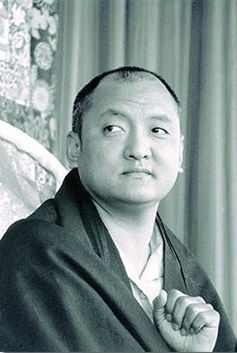
The Kunzig Shamar Rimpoche
A teaching given at the Karmapa International Buddhist Institute (KIBI), April 1994
The Ngondro practice is very important for purifying negative karma and to generate wisdom. Actually, our main practice is Mahamudra, but you cannot practice Mahamudra without the purification or the blessing. In this context, the “Preliminary Practices” are most essential.
You are in samsara now, and as long as you remain thus, you will experience disturbing emotions. Otherwise, you would already be enlightened. In the past, no matter where you were born, you experienced various poisons of the mind. This is true regardless of whether you were in the higher realm of beings or whether you were born in the lower realms. Your present state is proof of that, because were it different, you would not be experiencing disturbing emotions now.
The Ngondro practice is very important for purifying negative karma and to generate wisdom. Actually, our main practice is Mahamudra, but you cannot practice Mahamudra without the purification or the blessing. In this context, the “Preliminary Practices” are most essential.
You are in samsara now, and as long as you remain thus, you will experience disturbing emotions. Otherwise, you would already be enlightened. In the past, no matter where you were born, you experienced various poisons of the mind. This is true regardless of whether you were in the higher realm of beings or whether you were born in the lower realms. Your present state is proof of that, because were it different, you would not be experiencing disturbing emotions now.
So long as these disturbing emotions are in you, you are accumulating negative karma. However, it is not as if a certain karma was accumulated, it would then ripen to give a certain result, and afterwards, that karma would disappear completely. And that the only karma left in us now is what has caused this present human life. No, you have millions of different karmic imprints built up from many past lives. In addition, you are continuing to create much new karma through your thoughts, speech and actions everyday. Sometimes they are positive, sometimes negative. But unfortunately, they are most often negative. As humans, we are constantly involved in disturbing emotions which can never result in anything positive.
This does not mean that we should belittle ourselves. Rather, we should accept our present situation - this is our karma now, and it is preventing wisdom from appearing. This wisdom is already there. It is the nature of our mind. However, our disturbing emotions cover it. From our disturbing emotions we create karma. The result for us is more samsara where we create more karma.
So our karma is very strong. We weaken it by doing the “Preliminary Practices” until it cannot harm us any more. We practice the accumulation of merit through the Mandala-Offering, the third of the Ngondro practices. This will create in us all the necessary conditions to reach enlightenment.
When we are freed of karmic influences and have accumulated all the positive conditions, we can successfully begin the Mahamudra practice. If, however, after 111,111 repetitions of each of the four preliminaries, we realize that no development has occurred, then we have to continue to work hard on the preliminaries in order to weaken the negative karma.
While practicing Ngondro, many good signs may appear. They are an indication that a result has been reached. But one should not have too many expectations regarding these signs. They should appear naturally as they cannot be artificially produced.
After having practiced Ngondro extensively, students receive the Mahamudra teachings. It would not be very beneficial to teach them the Mahamudra before that because they would not be able to understand them precisely. The mind must be purified for that to happen.
As well, the more profound aspects of Mahamudra should not be taught too early, as students would not be able to appreciate them at a later time. When one has not understood the precise meaning of something, and yet has heard a lot about it, it becomes boring and confusing, and the effect of the meaning is lost . For this reason, great masters like Milarepa, and Gampopa transmitted the Mahamudra teachings only in a very restricted manner.
It has been said that the Preliminary Practices are more profound and more important than the main practice. This is because Ngondro creates the necessary conditions for the Mahamudra practice. Mahamudra enables you to reach enlightenment within one moment, but in order to do so, you first need the proper conditions.
By doing the Ngondro practice you turn yourself into a “qualified practitioner”. However, this does not mean that when you’ve finished you are fully qualified. In addition, you need a good understanding of the Dharma. For instance you should know the teachings about the qualities of Buddhanature. This subject is explained in the Uttaratantrashastra, Gyu Lama in Tibetan. Other important texts that you should study are: The Distinction Between Consciousness and Wisdom (tib: Nam-she Yeshe) and “Showing the Essence of the Buddha Nature” (tib: Nyingpo Tenpa) [both texts were written by the third Karmapa Rangjung Dorje]. The Nyingpo Tenpa is a shorter version of the Gyu Lama.
It is also important to know the Madhyamaka teachings. Madhyamaka explains in what way samsara is an illusion, and that the Buddha mind is beyond this illusion. As a result, one understands that samsara and one’s mind in its current mode are only delusions. The Buddha mind is something altogether different, something beyond this illusion. However, it is not different in the sense that it is separate from the present mind. Both are inseparably one. Madhyamaka explains exactly in what way the nature of your present mind is the Dharmakaya. But Madhyamaka is not able to point out the Dharmakaya as something special like one could point at a flower and say, “This is a white rose.” What the Madhyamaka can do is show the precise nature of the illusions. In addition to that, there is something that you have to recognize and understand by yourself: Mahamudra realization. For a meditator on this path, it is very important to learn the philosophical views of the Madhyamaka.
The Madhyamaka also explains that the conditions of “cause and effect” will continue as long as the mind is under the influence of illusion. Positive or negative causes always lead to corresponding results. This is why meditators with the Madhyamaka view have great respect for the law of karma. Even Bodhisattvas on high levels will experience the results of unpurified actions in the postmeditative phase. Due to their great merit, they generally encounter good and positive results. But sometimes, during their postmeditative phase, disturbing things may appear to them.
So the Madhyamaka is very important, as it leads to a fundamental understanding of the Dharma in its entirety.
Today, some scholars have also published books with short, comprehensible explanations about certain parts of the Abidharma. For instance, the different stages of Shinay meditation which a meditator goes through are explained. There are many details concerning how the philosophical view on different levels will affect certain forms of ignorance and disturbing emotions in the mind. During the continuous development of Shinay meditation, it is important to know these details precisely. Why? Because when you rest in deep meditation, you are more likely to be led by your deep knowledge than by an outside person. Therefore, if your knowledge is good, you will not encounter any obstacles. Without this knowledge, however, there are many risks of being misled during meditation. Sometimes you may perhaps follow wrong views which you consider right. At other times, you may not know how to deal with certain intellectual problems due to a lack of know-how, or the necessary remedial methods. You may also become agitated about certain experiences; even then, you should not be attached to them. At that point, you need a good meditation teacher, otherwise there is great danger of making mistakes. When you do a practice for the accumulation of merit, you need a teacher who knows about it specifically. The teacher need not necessarily have mastered all the other Dharma subjects, but he or she should be qualified to give you advice on merit accumulation methods.
When meditators are confronted with experiences during meditation, they need a teacher who is very qualified in this practice. An example I always enjoy telling is the story about Gampopa who once had a problem with his meditation practice - all of a sudden Gampopa could not see anymore. He crawled to Milarepa and asked him what he should do. Milarepa answered, “Your meditation belt is too tight. You should loosen it.”
If the meditation teacher has no experience of his own, he cannot teach you anything. In which book can you find the information about the meditation belt being too tight and needing to be loosened? Such books do not exist. Geshes and Khenpos could study all the Buddhist subjects for 25 years, but among all the books that can be studied, there is not one that explains such things because the number of beings is infinite and therefore the number of problems is infinite. Who could describe all the individual problems of all beings of the past, the present and the future? So when you come to these meditation experiences, the teacher needs to be qualified.
Another important point is the development of the Bodhisattva mind. It is the cause for our development from one lifetime to the next. For this reason, all Mahayana and Vajrayana teachers advise us to concentrate on Bodhicitta, the compassion aspect of the Bodhisattva’s mind.
The “Bodhisattva Vow” helps to develop our positive side so we become able to help other beings. It prevents us from falling into the lower realms as a result of anger or jealousy, etc. Even if such disturbing emotions arise, the Bodhisattva vow immediately purifies them. This is why we should never give up on developing Bodhicitta.
Anger and jealousy directly affect your Bodhichitta, as does the ego. They are your enemies. The three mind-poisons are the reason why beings are always so aggressive. There is so much anger everywhere. When energy is connected with that anger, beings become dangerous to others and create in themselves the causes to be reborn in the lower realms. The Bodhisattva Vow is one protection against the lower realms. The accumulation of merit, (the Mandala practice is one example), is increased by the Bodhisattva Vow as well as by the power of the purification practices.
Fonte:http://www.dhagpo-kagyu.org/anglais/science-esprit/chemin/medit/methodes/nongdro.htm